Friday, 15 March 2013

Martina’s New Wheels


Back in February, as part of our project research, the team and I travelled to Wiaga to meet a local women’s group to find out more about the Feok Festival. We’ve visited a number of women’s groups in the district to learn about how the groups are involved in the Feok and find out their thoughts on the participation of PWDs (people with disabilities), as we aim to include them in future festivals. It was an insightful meeting and the women of Wiaga were very warm and welcoming.

There was one woman in particular that stood out in the meeting. Her name was Martina, a young mother from Wiaga who was unable to use her legs. She sat with crutches beside her and a baby on her lap, who was often passed around. She was very vocal in the group, voicing her opinion on the Feok Festival and PWDs whilst laughing and joking. Martina was very positive, which was refreshing to see, and I later found out that she also works as a seamstress.

Considering her physical ability, whilst having to raise a child and go to work, I truly admired her positive attitude. Unlike a small number of PWDs that we have met, Martina had a fantastic ‘get up and go’ attitude. It made me realise that most of us take things for granted and moan and worry about the silliest things. Life on crutches alone with a baby cannot be easy.  

At the end of the meeting the women approached us to thank us and say goodbye, whilst Martina approached our national volunteer, Festus, to tell him about her mobility bike. Speaking in Buli, she told Festus that her bike had been broken for sometime and she cannot use it, making travelling and day-to-day tasks difficult. Festus acknowledged her request for us to help her, whilst she thanked us (in English) for visiting and said goodbye. 

We’ve had a lot of requests from disabled (and able bodied) people when visiting the different community groups in the Builsa District. We’ve visited a number of disabled peoples organisations, mental health organisations, schools and women’s groups who have all made requests. Some inform us of the problems they face and the resources they need, whilst others reel off a wish list of wheelchairs, stair lifts and mini buses.

Although we would obviously love to help with the said items, they all cost money - a lot of money. We do record these requests, which can be discussed at a later date, however, CBR, the organisation we work with, don’t have the money either. This is when I had a light bulb moment after hearing Martina’s plea.

Martina's new wheels!
I decided that I would pay for her bike to be fixed. If I brought the issue up with CBR it would have sat in a long queue of other requests and may have never been resolved. Knowing her story and having met her I decided that I wanted to help.

The following week en route to Fubisi, we asked our driver, Kwame, to make a stop off in Wiaga so I could visit Martina’s home and see what work her bike needed. After asking directions from pupil at a near by school, we finally found her at her home; a dingy concrete room filled with cooking utensils, with a large mosquito net filling half of the room with her baby daughter sleeping soundly beneath it. At the back of the room, underneath an old wheel chair, cloth and crutches sat the mobility bike. Coated in dust, it was obvious that it hadn’t been in use for a long time. Three years in fact, as Martina told us. She said that it was a gift from a group of Canadian volunteers, yet the wheels and chain needed replacing. 

We took her number and Festus contacted a repairman who later met us in Sandema town to buy the parts needed. In total, to repair and buy the new parts cost only 83 Ghana cedi, which is around £28.62. I spend that in a heartbeat whilst shopping in Leeds, so it was the easiest (and by far the best) £28.62 that I’ve ever spent.

Tyre shopping


Last weekend I received a text from Festus to hear that the bike had been repaired and was returned to Martina. I was so excited to see her on it so I asked if Kwame could drive me back to Wiaga for me to visit her. I met her earlier this week and she was so happy. The bike looked fantastic with its shiny new wheels. She got in it and cycled around to show me and kindly posed for some photos. 

Martina and her daughter
She told me that she was very grateful that I had it fixed for her as she had her mobility back. She can now travel around with ease and more importantly, take her daughter with her, who can sit beside her in the chair. In the past, Martina had to leave her daughter with someone else whilst she struggled with her crutches. Now, her little girl can travel with her wherever she goes.

It has been amazing to have had the opportunity to help Martina and to actually see the difference it has made to her life. I’m grateful that I’ve had the chance to come to Ghana and to not only help people as part of our project but to also help others in the community. I’ll certainly never forget Martina and her new set of wheels.

- Jenna

Tuesday, 12 March 2013

Is it better for a Devloping Country to Develop through Trade or Aid?


Developing through Trade will help the economy in many different ways, trade will increase the exports of a country which will in turn help create jobs and these jobs will generate income.  These incomes will have many benefits for people as it will raise their standards of living and will increase investment in further production creating more jobs and increasing productivity. As incomes increase this will also trickle down to the poor as more jobs become available to them. Ghana also has a weak currency the Cedi which is usually seen as a bad thing but in terms of exports this is good as it means that their exports seem less expensive compared to other countries and they are therefore more competitive on an international level.  Currently Ghana’s main exports are oil, gold, cocoa and it currently exports France 19.1%, US 8.6%, UK 4.7%. However Trade Blocs such as the EU put tariffs on imports, therefore making it difficult for countries like Ghana to become internationally competitive.  This is against the idea of free trade and is making it difficult for countries like Ghana to trade internationally.

 Aid can take many forms; it could be relief aid, one government giving money to another, an NGO giving money to those in poverty or training people in skills which will help them develop. It is often the case that developing nations don’t have the funds to build infrastructure and infrastructure is vital for a country to develop.

Overall I believe that the best way for a country to develop is through a combination of trade and aid.  Trade is vital for a country to develop many African countries have stumbled on the development ladder due to problems such as aids, civil war, corrupt governments which all hinder a countries development. Once a country has reached a certain level of development then I believe it is right to cut off aid as they can now cater for themselves and that aid can go elsewhere where it is needed.  Many African nations still rely heavily on Aid and they desperately need it.  


The Foster Home


On Friday the group of International Service ICS volunteers who are working with the charity RAINS in Tamale, came to visit Sandema. We decided to take them to the Foster home where our Dutch friend Mieke volunteers.

Some Friday nights at the Foster home, devotion time after their meal is spent singing, drumming and dancing.  We have made friends with many of the children, staff, and volunteers there, and they have made us feel so welcome.  As a treat, we brought ice cream for everyone!  The Tamale team had had a very long day and looked tired when they first arrived but after an ice cream they were up and dancing. Ben particularly made a friend in Gilbert, one the youngest boys at the home making him his dance partner.  Gilbert is one of the quietest of the children at the foster home, but he would quietly take Ben's hand and demonstrate the dances to him; Gilbert is a much better dancer than Ben (sorry Ben!).

We had a great time copying all of the dances which the children taught us. They are much more energetic (and fitter!) than us than us though! My dance partner was Solomon; when we did a dance which was similar to doing “Burpees” he managed to do two in the time which I had struggled to do 1. 
Amelia and Charlotte from the home once again made us made us all look on in amazement at the speed, and gracefulness of their dancing. 

This was another truly fantastic night which was full of laughter; I’m sure that the Tamale group really enjoyed it. We always feel welcome at the foster home and the children who live their always greet us with a smile and a big hug. We look forward to our next visit and we will really miss all of the children when we leave!

Friday, 8 March 2013

Tonight Matthew, I’m going to be…. Eoghan


CBR, the fantastic organisation that we’re working with in Sandema, do lots of work for the people of Builsa. As well as working with and improving the lives of people with disabilities, they also offer support in a number of other areas including health and education. Last week, we had the opportunity to assist the CBR staff with a health screening at a school in Bechonsa. CBR carry out regular screenings in schools across the district to identify health issues and disabilities amongst the children.

We travelled to Bechonsa in the trusty CBR vehicle with project officers Joseph and Francis, along with staff from the Builsa District Hospital. With the car full, Tracy, Poppy, Will and I were left to sit in the trunk with Joseph. It was a little bit of a squeeze, but cosy all the same.

We arrived at the school to be greeted by a sea of children, aged between three and eleven, who were sat patiently waiting for their check ups. The CBR team and the medical staff set up in an empty classroom, where the children would be examined by Joseph, who specialised in physiotherapy, a physiatrist and an eye specialist.

We were each designated a role to help out; Tracy was with the children, sending them one by one to be examined, Poppy and Will made a tally of male and females who were checked, and I waited by the doorway assisting the children in and out of the makeshift medical room.

The doctor will see you now...

 It was an enjoyable experience, as it was something none of us had ever done before. However, it was upsetting to see the appearance of some of the children, as some were missing hair, revealed bloated stomachs and bowed legs. Luckily, no major medical cases were found and the majority of problems, such as eye infections stemmed from a lack of hygiene. This, I found frustrating, as it is such a simple task that can be prevented. Although in this area of Bechonsa, as mentioned in Tracy’s previous post ‘How much can £10.50 get you in Ghana’, the closest source of water is 10k away and ‘having a shower comes secondary to drinking’.

The lack of hygiene issue was noted and brought up by the eye specialist, who complained to the teacher for not having a health specialist in the school to teach the children basic hygiene routines. During my time in Ghana, I’ve realised that it’s the little things that make the big differences.

One of the pupils having an eye test

 In total the health specialists examined over 200 children. It was a great insight into different areas of CBR and was lovely to have the opportunity to work with and meet other staff members and the children.

200+ kids down and we decided to pack up to leave. Back into the trunk we went for the long journey back, frying in the heat as we sat bare to the sun. I can honestly say it’s the hottest I’ve been (which I’m currently doubting right now, as I sit here typing this). We all alighted with a rosy glow and in some cases a healthy looking tan. I’m looking at you William, or should I say Eoghan!

As Poppy and I sat in the trunk with out backs to the car, Tracy and Will sat at the opposite end, getting the worst of the dust that blew out from behind them. Mixed with wind and sweat, Will looked like a different man once we arrived back in Sandema. His hair was stood upright, embedded with sweat and dust, giving it a sandy/ginger tint, and his face looked like he had a spray tan as it was coated in dust, sitting heavy in his eyebrows. It was hilarious!

If you’re able to view a photo right now, count yourself lucky (and I’ll probably owe Will 10 Ghana cedi for allowing me to upload it). If not, imagine Dale Winton with blonde hair, aged around 70. Poppy and I christened Will’s new look, Eoghan [say it how it's spelt for added effect], after the failed X-Factor contestant, Eoghan Quigg, as he developed a camp Irish accent that went with his new look perfectly.

Introducing Ghana's Irish mega star... Eoghan.


- Jenna 

P.S Many thanks to Will-i-am for letting me finally upload Eoghan

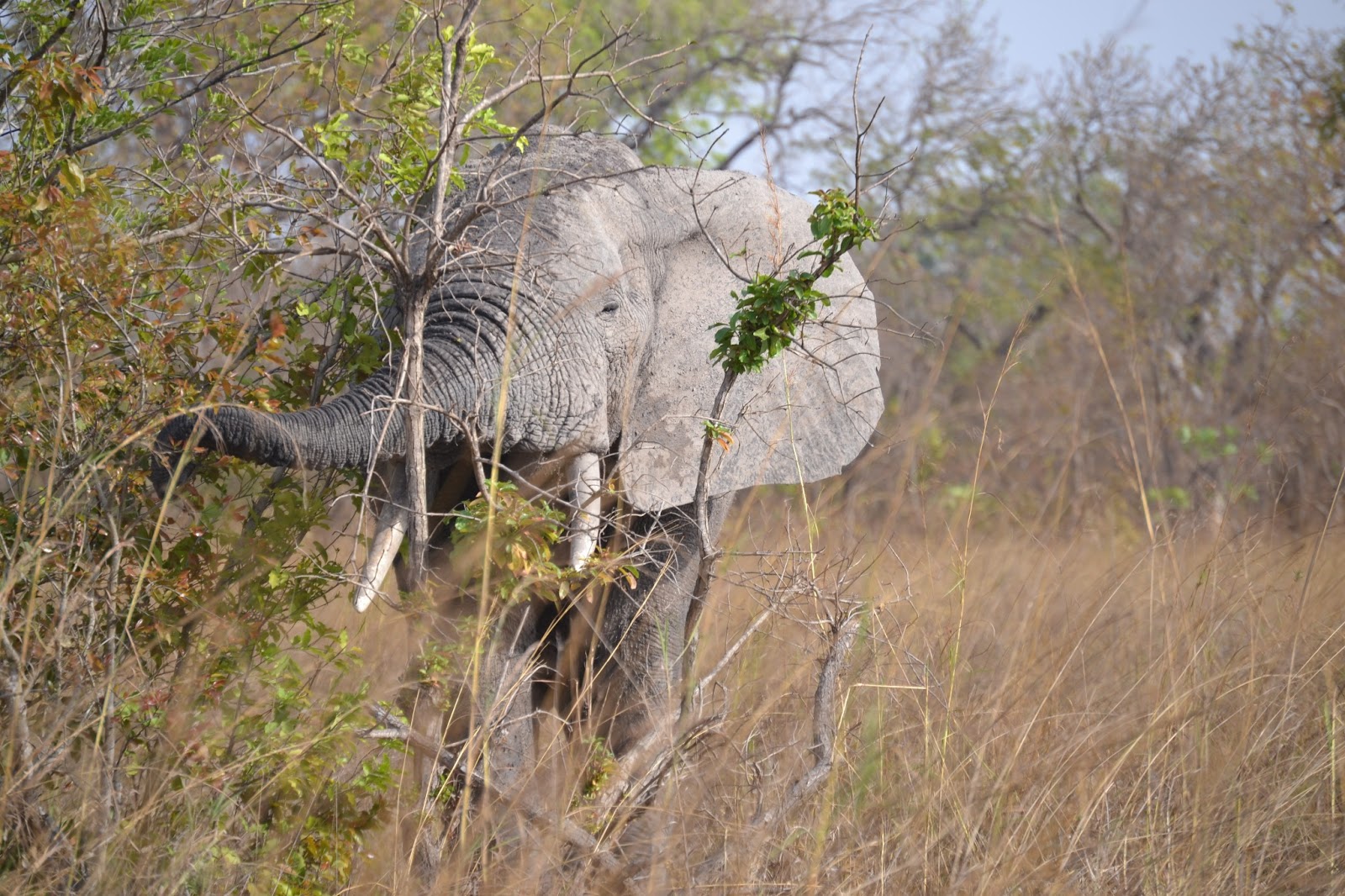
Elephants? Where?


Thursday, 7 March 2013

Charles Taylor...


On the 5th of March we visited Charles Taylor in Chuchuliga, a blind guitarist who has taken part in the Feok previously. We have heard a lot about Charles as he is very popular and well known within the Builsa district. He was incredibly welcoming and positive about the project and his involvement. Charles Taylor and his band partner sang us two songs with their homemade guitar and painted calabash, being used as a drum – they sang one song in English which went something along the lines of “it’s a happy day, call my friend, I want to speak to her, it’s a happy day”. He was an inspiring man who didn’t once mention his disability as a hindrance, only saying he would like to make an album to sell! Once we had interviewed him, he very generously gave us a chicken! Absolutely terrified about how to hold it at first, I began holding it like a baby, to our drivers’ amusement. We became quite attached to Charlie the Chicken as he fell asleep on my knee on the drive home. Once we were home, we were at a loss of what to do with Charlie! So naturally we gave him water and cornflakes and stuck him on the veranda (which he escaped from) luckily, Alpha male Festus managed to grab him just as he made a break for freedom over the compound wall. We fashioned a lead and let Charlie chill out for a few hours before the inevitable happened… we had a lovely chicken stew that night (poor Charlie!)

Wednesday, 6 March 2013

Time flies when you're having fun!


I can’t believe it is March already.  It seems only a few weeks ago the four of us UK volunteers arrived in Sandema, with Festus, eager and excited to start a new project.  And now, 8 weeks later Jenna, Poppy, and Will are on the countdown to departure day.

In the past 8 weeks, the team have visited 13 Chiefs and their entourages of elders, and sub-chiefs; 4 women’s groups, 5 Disabled People’s Organisations, 4 schools, spoken to many people at the District Assembly, attended a local Feok festival, and met a famous (blind) guitarist (well, famous in Builsa!).  That doesn’t include appearances on the radio or any of the things we have done that are non-project related! The month of February disappeared in a blur, interspersed with trips to sit on crocodiles and hang out with Elephants and Baboons in Mole National Park.  We have been sang to, danced for, had our accents laughed at, teased for our names (Jenna means eggs in Buli, and we are forever explaining that Poppy is not a small dog!), and had our hands shook by hundreds of wonderful, and gracious people.

There are only 2 and a half weeks left to work on the project (the last week will be spent debriefing, packing, saying goodbyes, and travelling to Accra).  We have a few tasks remaining, including visiting St John’s Integrated Senior High School, in Navrongo (a school which welcomes children with disabilities alongside their able-bodied colleagues) and Gbeogo School for the Deaf, in Tongo, Bolgatanga.  As this team draws to a close I am starting to think in more detail about the next team’s activities, and so these visits to these schools will help formulate ideas and identify ways in which we can develop Feok-based activities for people with disabilities to participate in.  I want the current team to be involved in kick-starting this process so that there is some form of overlap between teams; it will almost be like handing over the Olympic flame as it journeyed across the UK, and visiting these schools will certainly help.  This team have been instrumental in laying the groundwork for the LIFE project, and will be key figures in the remaining weeks in advocating for improvements to the festival, and more importantly, for the inclusion of people with disabilities.  (The next team will (hopefully) build on this by introducing some disability-friendly, and Feok friendly, activities to the Builsa district.)

Our main remaining task, then, is to bring all of the Chiefs, Assemblymen and women, Disabled People’s Organisations, schools, women’s groups, key opinion leaders, and inspirational people with disabilities together and report our findings.  This is both incredibly exciting but also quite terrifying.  On the whole there has been a great deal of positivity directed towards the inclusion of people with disabilities from everyone we have spoken to, and I don’t anticipate there being any resistance from the Traditional Council and District Assembly to the development of activities (I do anticipate them telling us we can do what we want, just don’t expect them to pay for it!).  However, for there to be any point in including people with disabilities into this festival, there are some issues regarding the festival itself that need to be addressed.  It is this bit that makes me nervous.

The Paramount Chief of the Builsa District, until 2006, was a man named Azantilow.  He was incredibly well-liked and respected, not only in the Builsa District, but across Ghana, and around the world.  The Queen and the Royal Family were apparently big fans also.  There is a story that Azantilow refused to die until he had spoken to the Queen one last time, and so an ex-pat NGO worker was drafted in to imitate the Queen to give Azantilow her best wishes.  Some versions of this story say the ex-pat was made to wear a wig, but Azantilow had gone blind in his last few years, so I’m not sure how true this bit is.  Azantilow, glad to have received the Queen one final time, died the very next day, aged 106. Unfortunately, the responses from our interviews, questionnaires, and focus groups suggest that the Feok festival has never been the same again, and since Azantilow’s death, there have been several disputes and conflicts between the current Paramount Chief and the Builsa Community Chiefs.  Whilst we do not necessarily aim to address these issues at our meeting in a few weeks, they are something we intend to raise and hope to set the wheels in motion for resolving them.  I’m just not sure how happy the current Paramount Chief, Azantilow’s son, is going to be when we raise them.  Mum, I might be home in a few weeks if the Chief doesn’t like what we have to say!

So, all the sections of the report have been written and we are now in the process of editing it all together, and putting together our conclusions and recommendations. Tomorrow will be a big planning day for the meeting as we finalise venues, catering, guest lists and start work on the meeting agenda!  It might be the last two weeks, but this team still have a lot to do!!